
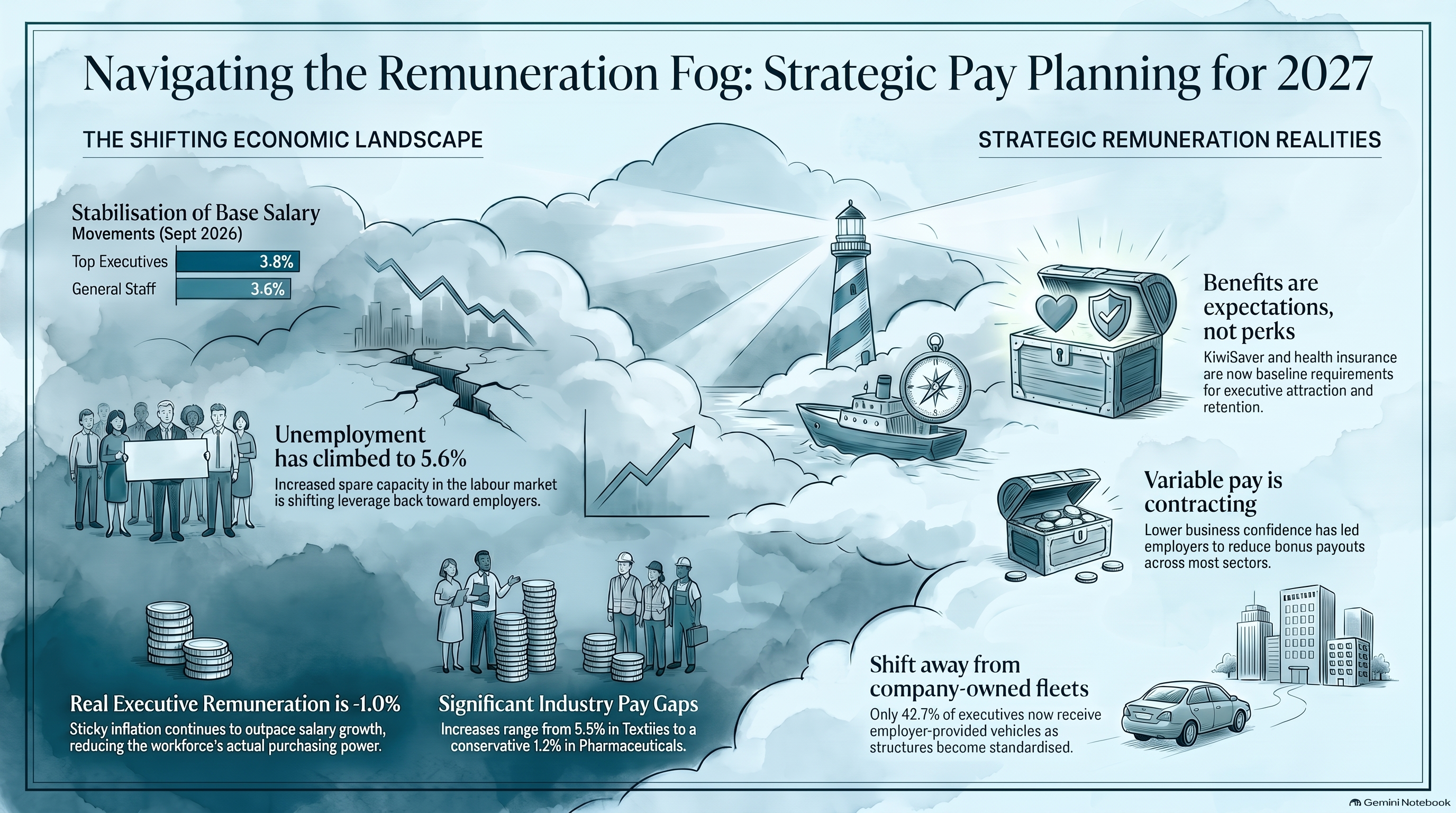
Navigating an uneven economic recovery defined by Middle East fuel shocks, volatile inflation, and climbing unemployment (5.6%), organisations face an evolving remuneration landscape. As market leverage shifts firmly back to employers, salary momentum is cooling. Yet, with CPI at 4.1% (June 2026) continuing to squeeze real purchasing power, the challenge for the 2027 budgeting cycle is acute. How can leaders balance fiscal discipline with key talent retention? In this post, we unpack the latest MHR Global pay survey results to help refine your strategic remuneration roadmap.
The Economic Backdrop
The New Zealand economy is currently evaluating an uneven recovery, characterised by volatility and persistent uncertainty. As we move into the latter half of 2026, the economic environment remains uncertain. High fuel prices, driven by Middle East instability and disruption in the Strait of Hormuz, along with a volatile inflationary environment, have made forward planning a challenge for employers. While export incomes in regional sectors remain resilient, the broader consumer market is constrained by a loss of purchasing power and elevated interest rates. This cooling is manifest in the labour market, where unemployment has climbed to 5.6%, increasing spare capacity and shifting market leverage back toward the employer. We have distilled these complex signals along with the results from our latest MHR Global pay survey to assist your organisation in refining its remuneration strategy for the 2027 budgeting cycle.
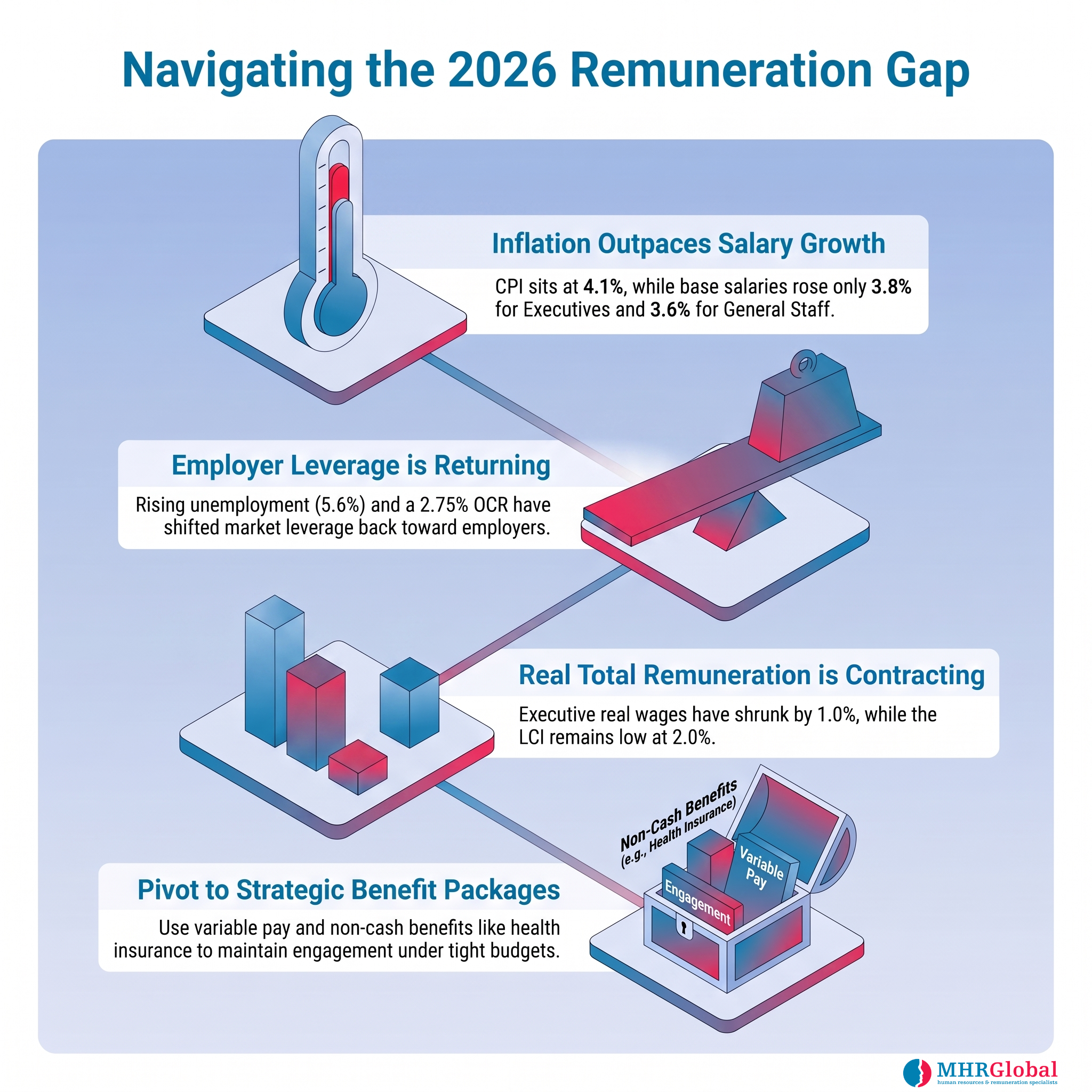
Our data indicates a distinct stabilisation in base salary movements compared to the aggressive adjustments of previous years. For the period ending September 2026, we recorded a national average base salary increase of 3.8% for Top Executives and 3.6% for General Staff.
- Top Executives: 3.8%
- General Staff: 3.6%%
From a strategic perspective, relying on national averages is increasingly deceptive due to sector-specific volatility. There is a significant industry gap across the country. While Textiles, clothing, and footwear report Top Executive increases of 5.5%, the Pharmaceuticals sector has remained conservative at just 1.2%. This disparity highlights the need for precise industry-specific targeting rather than relying on broad market trends.
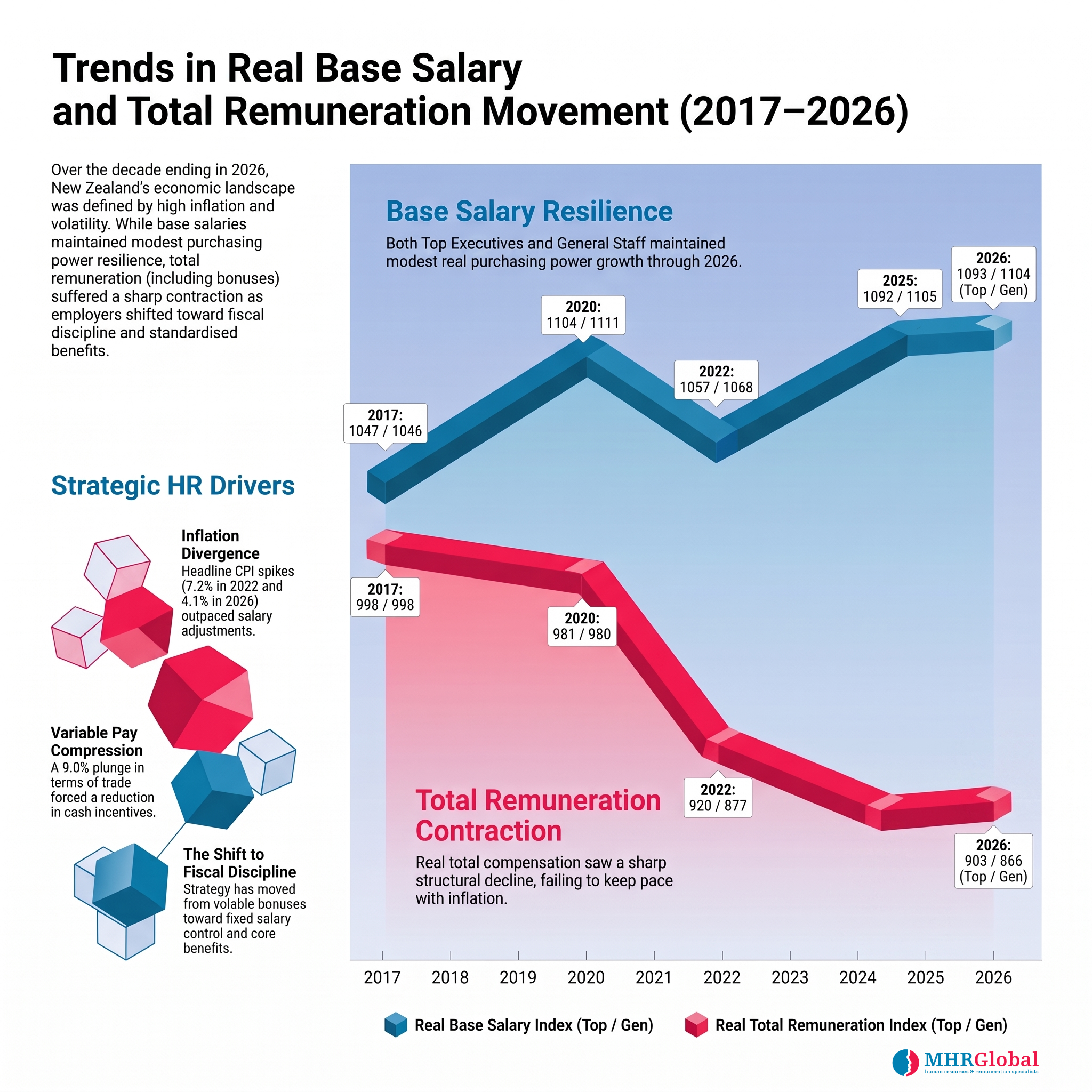
Historical Perspective: The 10-Year Trend
The 2026 results represent a cooling phase following the extreme pressures of the mid-2020s. Between 2017 and 2022, salary movements remained moderate and predictable within a low-inflation environment. Momentum accelerated sharply over 2023–2024 as inflation expectations broke and severe talent shortages took hold. By 2025, movement peaked at a 10-year high of 4.6% for Top Executives and 4.4% for General Staff as firms scrambled to offset soaring CPI. The current drop to 3.8% and 3.6% marks a clear shift in leverage back to employers in a cooling market.
Total Remuneration Shifting Gears
While base salaries have maintained some momentum, total remuneration – incorporating bonuses and variable pay – has contracted. The median total remuneration movement for 2026 has slowed to 3.6% for Top Executives and 4.1% for General Staff.
This marks a sharp slowdown from 2025 results of 4.8% and 4.6% respectively. The drop is also linked to the 9.0% plunge in merchandise terms of trade recorded over this period. This loss of purchasing power, combined with lower business confidence caused by the oil price shock, led employers to reduce variable pay payouts. With unemployment at 5.6%, the urgent retention mentality of 2025 has been replaced by cost discipline.
Real Movement and the CPI Impact
The intersection of remuneration and the Consumer Price Index presents a challenging narrative for 2026. In June, CPI spiked to 4.1%, and is projected to remain high (around 3.7 percent) for the September quarter. These oil-price spillovers have resulted in sticky inflation that has outpaced salary growth. Consequently, real remuneration movement remains constrained, although there has been a minor uplift for General Staff.
- Real Total Remuneration (Top Executives): -1.0%
- Real Total Remuneration (General Staff): 0.3%
Strategic managers must recognise that despite nominal increases, the actual purchasing power of their workforce continues to lag CPI. As inflation remains volatile, the recovery of real total remuneration will be slow, necessitating a focus on non-financial value propositions to maintain engagement.
Bonuses and Benefit Provisions
The 2026 survey data confirms that while variable pay amounts are shrinking, benefit structures are becoming increasingly standardised.
- Bonus Payments: Median bonus levels for 2026 represent 11.4% of Total Remuneration for Top Executives and 5.2% for General Staff.
- Motor Vehicle Distribution: Recent surveys show a shift away from company-owned fleets. In 2026, 42.7% of Top Executives and 4.2% of General Staff have employer-provided vehicles (e.g., executive sedans or small and medium SUVs). The traditional company car is no longer a major differentiator.
- Benefit Provisions: Key provisions are now provided to significant numbers of surveyed Top Executives, including KiwiSaver employer contributions, medical/health insurance, and additional annual leave.
How accurately does the theory fit reality in your organisation? The high provision rate for these items suggests they are no longer perks. In the 2026 market, these have transitioned into baseline expectations for executive attraction and retention. Removing or reducing these benefits would likely be viewed as a departure from standard market practice.
Conclusion for HR Practitioners
For experienced HR managers, the 2026 data signals a time for precision over generalisation. In a low-growth, high-inflation environment, the margin for error in remuneration management has narrowed. We recommend moving away from broad economic theories and focusing on specific market positioning based on hard market data. The current uncertainty in economic and labour market conditions requires practitioners to be disciplined. With real total remuneration movement remaining low, the challenge is to balance fiscal responsibility – informed by lower business confidence – with the need to protect core talent. Success in this environment will be defined by well-structured base pay and the consistent delivery of baseline benefits that the market now considers mandatory.

