
MHR Global has just released the findings from our March 2026 pay survey. It’s worth noting upfront however, that the data was collected before 28 February 2026, which is when the first USA/Israel strikes on Iran took place. That means the survey largely captures decisions that were made before the conflict began, and before the global fuel crisis that followed, so the analysed data doesn’t reflect how either of those things has started to affect pay practices on the ground.
To fill that gap, this article looks at how New Zealand’s current fuel and energy crisis is already changing the shape of the labour market, covering both the results of that survey analysis, and what we’re starting to see in recruitment, retention, and remuneration as of March 2026.
1. Let’s start with the honest picture
The days of cheap labour and cheap fuel are over, and they’ve ended at roughly the same time. For New Zealand organisations, that’s a double hit: global energy disruption on one side, and very real local business pressures on the other. We’re in a period where geography and access to energy are shaping economic decisions more than any financial lever we’ve pulled before.
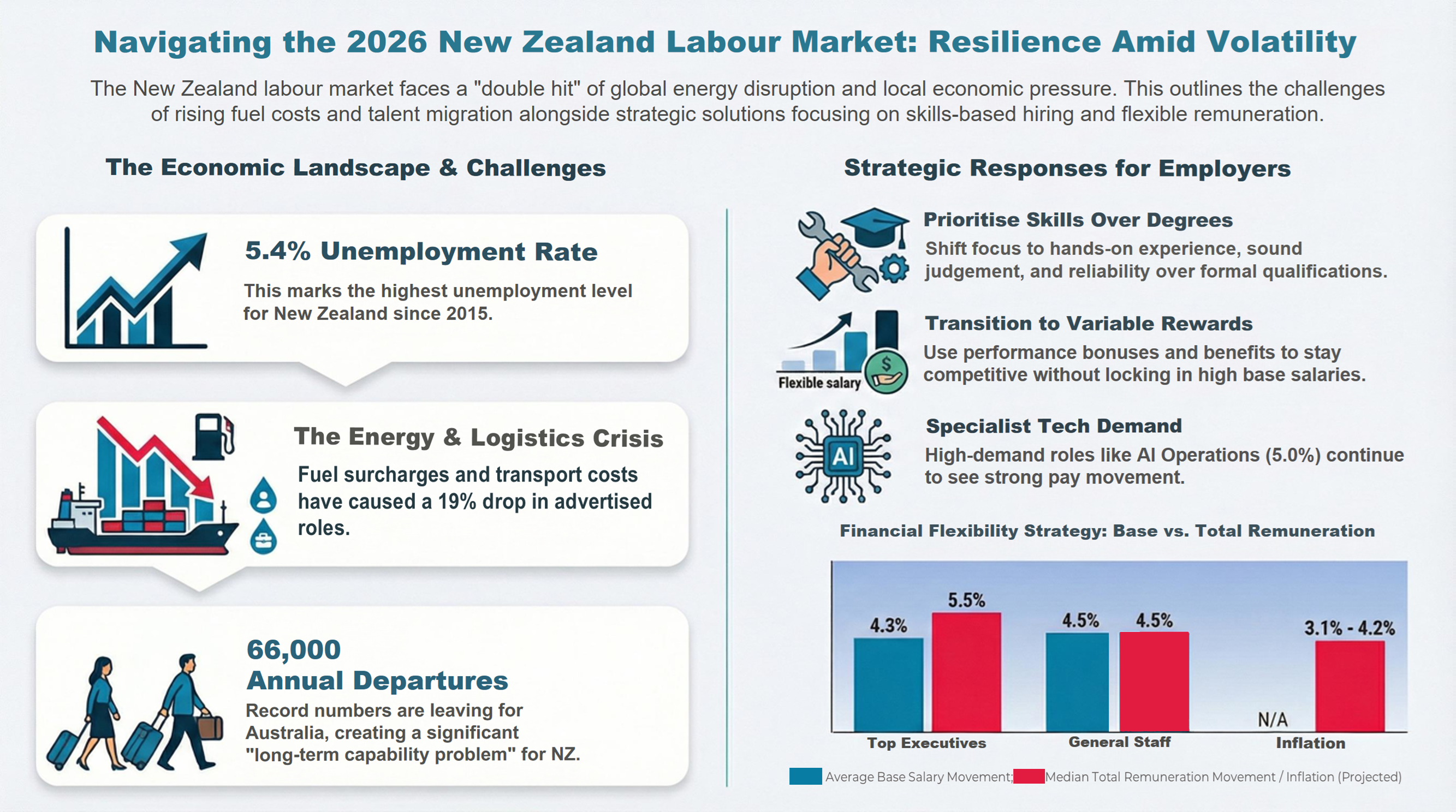
The closure of the Strait of Hormuz has knocked out around a quarter of the world’s seaborne oil trade. For New Zealand, which has had to import all of its refined fuel since Marsden Point closed in 2022, that’s sent shockwaves through the whole economy. At the same time, unemployment has climbed to 5.4 percent, the highest we’ve seen since 2015. The twist is that business confidence had actually been sitting at a ten-year high just before the Middle East crisis kicked off.
Those mixed signals make a lot of the usual HR playbook less useful. What’s working for organisations holding their ground right now is a simple shift in thinking: treat your people as a core asset worth protecting, not a cost to be squeezed, particularly as energy and logistics costs keep eating into margins.
2. What you can do matters more than your degree
Advertised roles dropped sharply by 19 percent in early 2026, and much of that is down to rising fuel surcharges and transport cost: when margins are tight, employers simply can’t afford to take a chance on someone who isn’t ready to hit the ground running, or whose main selling point is a qualification rather than actual capability.
Skills-based hiring has shifted from being a talking point to being a practical necessity. Employers are actively moving away from leaning on formal qualifications and towards people who can demonstrate they know what they’re doing.
The qualities that are getting attention right now are sound judgement, reliability, the ability to communicate clearly, and hands-on experience. These things are harder to automate and genuinely useful when supply chains go sideways. Organisations that are focusing on specialist capability and stepping back from routine, easily automated roles are building themselves some real resilience for a world where physical logistics remain unpredictable.
3. How to reward people without overcommitting
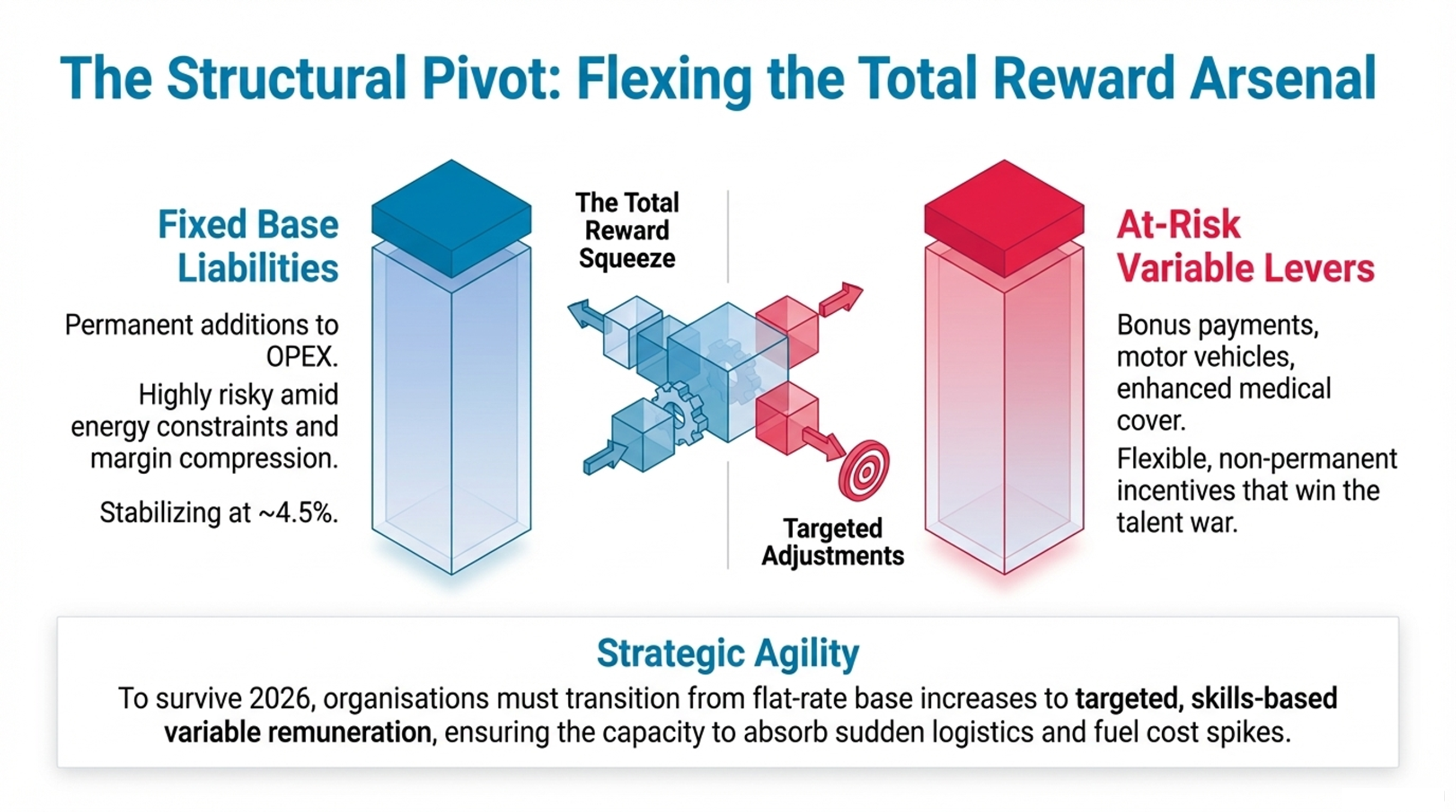
To stay competitive for talent without locking themselves into long-term salary commitments they may not be able to sustain, many organisations are leaning more heavily on variable rewards and targeted benefits. Rather than pushing base salaries up in ways that are hard to unwind when freight and fuel costs spike, employers are turning to performance bonuses and targeted benefits like company vehicles and enhanced medical cover.
The data backs this up. Base salaries for Top Executives grew by 4.3 percent, but median total remuneration grew by 5.5 percent. A growing number of senior leaders are now sitting above the $260,000 base salary mark, with a meaningful chunk of their overall earnings tied to how the business actually performs.
For the rest of 2026, this kind of approach becomes increasingly important. Moving away from blanket base pay increases and towards targeted, skills-based variable rewards gives organisations room to breathe when costs jump unexpectedly.
If you’re involved in pay decisions, here’s a practical way to think about it: use the 5.5 percent Median Total Remuneration Movement to set the outer boundaries of your salary ranges, then apply the lower 4.3 percent Average Base Salary Movement when you’re deciding on a tsargeted average for individual base pay increases. That way you’re staying market-relevant without taking on unnecessary financial risk.
4. The Australia problem isn’t going away
New Zealand’s workforce is under serious strain. More than 66,000 people left the country in 2025 alone, most of them heading to Australia for higher pay. With net migration sitting at just 14,200, the gap between who’s leaving and who’s arriving is getting harder to ignore.
That pressure is likely to get worse. Changes to the Skilled Migrant Category resident visa come into effect in August 2026, requiring migrant tradespeople to meet tougher local experience standards. Australian employers are already circling, actively recruiting workers who feel unsupported or uncertain about what the new rules mean for them.
If New Zealand organisations don’t actively help skilled migrants work through these changes, we risk losing people we already depend on to keep infrastructure, energy systems, and essential services running. That’s not a short-term inconvenience; it’s a long-term capability problem.
5. Pay is going up, but it doesn’t always feel that way
On paper, the wage picture looks encouraging. Average base salary increases for general staff reached 4.5 percent, which puts it comfortably ahead of projected inflation sitting between 3.1 and 4.2 percent. That’s the first time in a while that pay growth has genuinely outpaced rising prices.
But let’s be honest about the context. Even though general staff salaries are sitting 16.2 percent above the CPI baseline, total remuneration hasn’t yet made up the ground lost during the high inflation years of 2022 and 2023. For a lot of workers, real purchasing power still lags behind what it was in the mid-2010s.
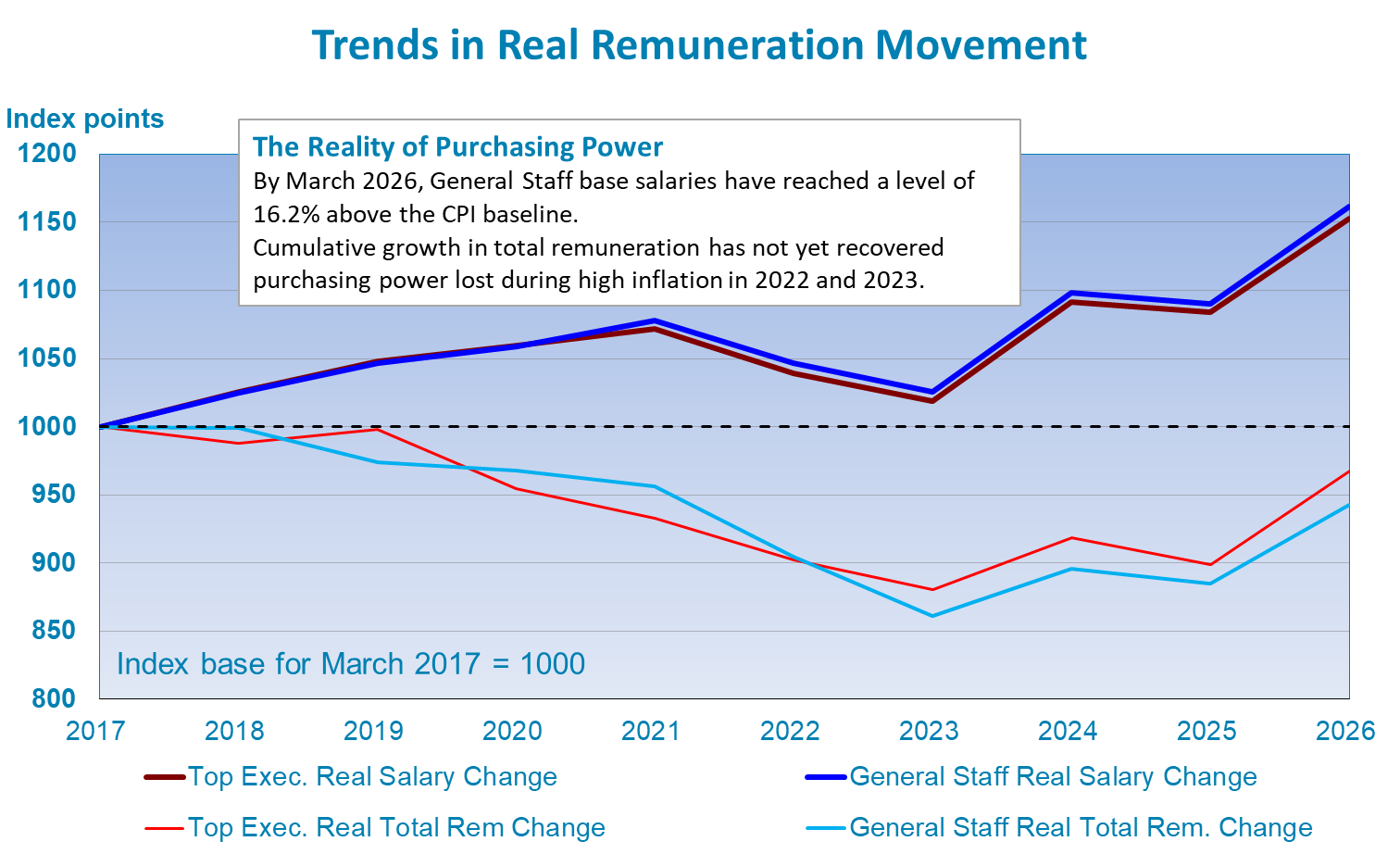
From where your employees sit, the improvement is real but modest. Pay is moving in the right direction, but it hasn’t closed the gap that a difficult decade of volatility opened up. It’s worth keeping that in mind when you’re having conversations about pay expectations.
6. Tech and AI roles are in a league of their own
While overall hiring is down, the picture isn’t the same across every part of the economy. Manufacturing and retail listings have fallen, but construction and roading roles have actually increased by 8 percent as major infrastructure projects push ahead.
What’s more striking is the group of specialist roles that remain highly sought after regardless of what the broader market is doing. These are the roles that support transformation and help organisations manage complex, expensive change.
Current pay movement in some of those areas gives a sense of the demand:
- High Technology Research and Development: 5.1 percent
- Artificial Intelligence Operations: 5.0 percent
Even as it becomes easier to find entry-level and lower-skilled workers, the competition for specialist capability isn’t letting up. Roles linked to advanced technology and AI are increasingly seen as essential, particularly as energy efficiency and smarter systems become a bigger part of how organisations manage costs and stay competitive.
7. What to keep in mind for the rest of 2026
The relative quiet we’ve seen in the first part of this year shouldn’t be read as a sign that things are settling down. The rest of 2026 needs to be planned for carefully. The Official Cash Rate is expected to settle around 2.25 percent, though there’s a real possibility of an increase later in the year if inflation pressures tied to Middle East instability continue to build.
The organisations that will come through this period in good shape are the ones building flexibility into how they reward people and putting real effort into keeping the staff they already have. Getting through this isn’t about cutting costs aggressively; it’s about managing your people and their capabilities wisely.
As energy security becomes an increasingly important factor in workforce planning, it’s worth asking yourself a straightforward question: is your organisation doing enough to attract and hold onto the skills and roles that will see you through the next major disruption?
Order a copy of the MHR “Pay Matters” report (March 2026 update) here.
 MHR RemBytes